When I think about the Lebanese Christmas table, I think about our Eid table. Different faith. Same spirit. The same generosity, the same abundance, the same food kept coming until nobody could move. The same long afternoon that turned into an evening that nobody wanted to end.
That is the Lebanese way — regardless of the occasion, regardless of the faith. When Lebanese people gather to celebrate, the table looks the same. It is set with care, loaded with food, and surrounded by people who understand that a meal shared slowly is one of the most important things you can do together.
Lebanon has a significant Christian population — Arab Christians who have been part of the fabric of Lebanese society for centuries. Their Christmas is not a quiet, restrained occasion. It is a full Lebanese celebration. The tree goes up, the church on Christmas Eve or Christmas morning, then home — and the table.
The food on that table is Lebanese food. Not a turkey, not a Christmas pudding. Lamb. Stuffed chicken. Rice. Vine leaves. Pastries. Salads. Kibbeh. And for the sweet table — mamoul, baklawa and the one dessert that belongs most completely to this time of year.

Christmas in Lebanon — what the celebration looks like
Christmas in Lebanon begins long before the 25th of December. The Feast of St Barbara on the 3rd of December marks the start of the festive season — families place wheat seeds on damp cotton wool and watch them sprout over the weeks leading to Christmas, a symbol of new life placed beside the nativity display in the home.
On Christmas Eve, the churches fill. Christmas Eve mass is attended by families dressed in their best, in Lebanese villages and cities alike. Then home — to the table, to the people, to the food that has been prepared across the days before.
Christmas Day is the long lunch. The meal that starts at midday and does not properly end until evening. Relatives arrive in waves. Coffee keeps being made. The good dishes are out. It is, in every way that matters, exactly like every other important Lebanese occasion — the same generosity, the same abundance, the same insistence that nobody leaves the table hungry.

The Christmas table — what is always there
The Lebanese Christmas table is built on the same foundations as every Lebanese celebration. The mezze arrives first — pastries, dips, salads — and then the mains, which on a Christmas table are generous and often include more than one showstopper. Here is what belongs on it.
To start — the mezze and pastries
Simply Hummus

Always made from scratch. Always on the table before anything else arrives. Dressed with olive oil, served with warm bread. This is where the Christmas lunch begins.
Baba Ghanouj

Charred eggplant mixed with fresh tomato, spring onion, parsley and lemon. Made from the fire. No tahini. Alongside the hummus with warm bread — these two dips are the foundation of every Lebanese table that matters.
Sambousek Lamb Pastries

The pastry that appears at every Lebanese occasion without question. Flaky, golden, filled with spiced lamb mince and pine nuts. Freeze them raw weeks ahead and fry straight from frozen on the day.
Sfiha Lamb Pastries

Soft, no-yeast dough filled with spiced lamb mince, pomegranate molasses and pine nuts — baked until the edges turn golden. These are the open-faced Lebanese pastries that have been on celebration tables forever. Make them ahead and reheat. They freeze beautifully.
Quick Laham B’Ajeen

The quick version using puff pastry — spiced meat on a crisp, buttery base. My shortcut version of the traditional Lebanese meat flatbread. Fast, impressive and always gone before anything else.
Kibbeh Nayeh — Lamb Tartare

Raw lamb mince blended with fine bulgur, onion and spices — served with olive oil, fresh mint and bread for scooping. Kibbeh nayeh is one of the most distinctly Lebanese things on any celebration table. For the Lebanese people who love it, it is non-negotiable at Christmas.
The mains — the showstoppers
A Lebanese Christmas table does not have one main. It has several — each one significant, each one feeding a crowd. Choose what suits your table. For a very large gathering, two or three of these together is not unusual.
Ouzi — Stuffed Lamb with Rice

→ Ouzi — Stuffed Lamb with Rice
A whole small lamb stuffed with spiced rice and chickpeas, sewn closed and slow-roasted for six hours until the meat falls from the bone and the rice inside has absorbed every bit of flavour from the lamb. This is the centrepiece of Lebanese celebration cooking — the dish that makes the whole table go quiet when it arrives. Your butcher needs to prepare the lamb correctly. Make the rice the day before. Give yourself the day.
Djaj Mahshi — Rice Stuffed Chicken

→ Djaj Mahshi — Rice Stuffed Chicken
A whole chicken stuffed with spiced rice and slow-roasted until the skin is golden. The Lebanese version of a stuffed roast — and a more accessible alternative to the ouzi for a smaller table. Every grain of rice tastes like the chicken cooked around it.
Lebanese Chicken and Rice — Ruz Ajaj

→ Lebanese Chicken and Rice — Ruz Ajaj
A whole chicken slow-simmered in a dark spiced stock, the rice cooked in that same stock until every grain is deeply flavoured, topped with shredded chicken and toasted pine nuts and almonds. For the table that wants the flavour without the stuffed presentation — this platter feeds a crowd beautifully.
Slow-Cooked Lamb Shoulder Roast

→ Slow-Cooked Lamb Shoulder Roast
A lamb shoulder rubbed with herbs and garlic, slow-roasted until the meat pulls from the bone without effort. Goes in the oven in the morning and asks nothing from you after that.
Lebanese Warak Enab — Stuffed Vine Leaves

→ Lebanese Warak Enab — Stuffed Vine Leaves – Mother in laws version

→ Lebanese Warak Enab — Stuffed Vine Leaves – Mum’s Version
Vine leaves rolled tightly around a spiced rice and meat filling, stacked in a pot and slow-cooked until tender. The pot goes on the night before and simmers gently — by Christmas lunch they are ready. A Lebanese Christmas table without warak enab is missing something.
Seafood — because Lebanese coastal tables always include it
Arabs love their seafood — and on a Lebanese Christmas table, particularly in coastal Lebanese homes, fish and prawns are a natural and important part of the celebration. This is not an afterthought. It is tradition.
Lemon Garlic Prawns

Juicy prawns cooked in a butter, lemon and garlic sauce — fast, generous and completely irresistible. On a Christmas table they arrive as part of the mezze or alongside the mains and they disappear immediately.
Samkeh Harra – Spiced Baked Fish

→ Samkeh Harra — Spiced Baked Fish
A whole fish baked with a spiced herb crust, finished with a creamy tahini sauce and scattered with toasted pine nuts. The great Lebanese fish dish — celebratory, deeply flavoured and beautiful on the table.
The vegetables and salads
Whole Baked Cauliflower with Tahini Sauce

→ Whole Baked Cauliflower with Tahini Sauce
A whole cauliflower roasted until golden and tender, covered generously in tahini sauce. Vegan, effortless and one of the most visually impressive things you can put on a table. Substantial enough to stand alongside the meat dishes.
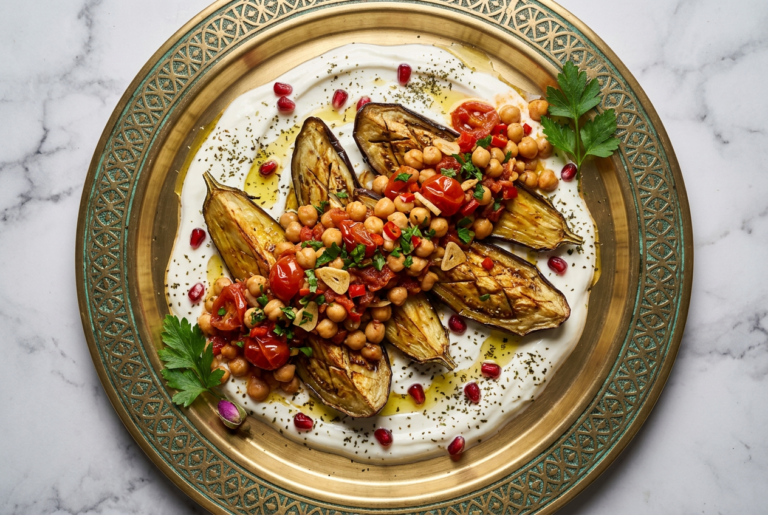
Baked Eggplant with Tangy Tahini Sauce

→ Baked Eggplant with Tangy Tahini Sauce
Roasted eggplant with a tangy tahini sauce poured generously over the top. Light, deeply satisfying and completely Lebanese. A natural companion to the rich lamb and rice dishes.
Tabouli Salad

All that fresh parsley, a little bulgur, tomato, spring onion, lemon and olive oil. Dress it at the last moment. The brightness of the tabouli cuts through the richness of the lamb and makes everything feel balanced.
Crunchy Fattoush Salad

Crisp greens, toasted bread, cucumber, tomato and pomegranate dressing. Both the tabouli and the fattoush belong on a Lebanese Christmas table — together if the table is large enough.
The Christmas dessert — Moghli
There is one sweet that carries a meaning unlike anything else on the Lebanese table. Moghli — a caraway and rice pudding, fragrant with cinnamon — is the dish of new birth. In Lebanese homes, Muslim and Christian alike, it is made when a baby arrives. Visitors who come to celebrate the new arrival are served moghli. It is the taste of welcome, of celebration, of something new beginning.
At Christmas, Lebanese Christians make it to celebrate the birth of Jesus. The same dish, the same meaning — the arrival of new life marked with something warm and carefully prepared. It is perhaps the most culturally specific food on the Lebanese Christmas table, and the one that connects the occasion most directly to its meaning.
Served cold in individual glasses, topped generously with toasted coconut, pine nuts, slivered almonds, walnuts and pistachio. The toppings are everything — their crunch against the soft pudding is what makes it. Make it the day before. Do not cover the toppings or they will soften.

→ Moghli — Caraway Spice Pudding
Gluten-free, vegan and completely unlike anything else on the table. Once you understand what it means and where it comes from, you will never skip it at Christmas again.
The sweet table — what comes out with the coffee
After the lunch, the table does not clear. The coffee starts and the sweets come out. Tins and plates appearing, things made in the days before, placed out for the afternoon that stretches into evening.
Walnut Stuffed Mamoul

The cookie of every Lebanese celebration. Made two to three days before, dusted with icing sugar, placed in a tin. Always the first to go.
Cashew Filled Baklawa

Layers of crisp filo filled with cashews, drenched in rose water syrup. Make the day before and cover with a tea towel — not plastic wrap. Looks stunning on a platter.
Ghraybeh Cookies

Melt-in-your-mouth, a pistachio pressed into the centre of each one. They sit quietly on the sweet table and disappear steadily across the afternoon.
The fruit table
A Lebanese Christmas table always has fruit. Not as dessert — as presence. A large platter of whatever is at its best in December — cherries, grapes, stone fruit, lychees — placed on the table and left there across the whole afternoon. People reach for it between conversations, between courses, between coffees. Abundance without effort. Always there.

Different faith, same table
I do not celebrate Christmas myself. But I know this table. I have sat at versions of it. I have watched Lebanese Christian families gather around it the same way my family gathers at Eid — with the same noise, the same generosity, the same insistence that everyone eats and nobody leaves hungry.
That is the Lebanese way. The occasion changes. The faith is different. But the table — the abundance of it, the care that went into it, the hours spent around it — is always the same.
If you are cooking a Lebanese Christmas feast this year, these are the dishes I would put on that table. Make too much. Set the table with care. Let the day take as long as it needs to.
Seasons greetings!
Looking for more Christmas inspiration? Walk through the step-by-step Middle Eastern Christmas lunch menu, or browse edible gifts for everyone on your Christmas list if you are looking for something to bring or give.
Cooking a Lebanese Christmas this year? Tag me on Instagram @roubasfoodjourney — I would love to see your table.